Statement
What Remains, What We Carry
I am interested in the histories held by objects and places—particularly those that are overlooked, altered, displaced, or at risk of disappearing.
An ordinary object can hold a remarkable amount of history. Its material, form, ornament, function, and method of production reveal something about the people who made and used it. Objects can preserve knowledge that is not written down: a way of making, a domestic ritual, a remembered place, or a cultural tradition passed between generations.
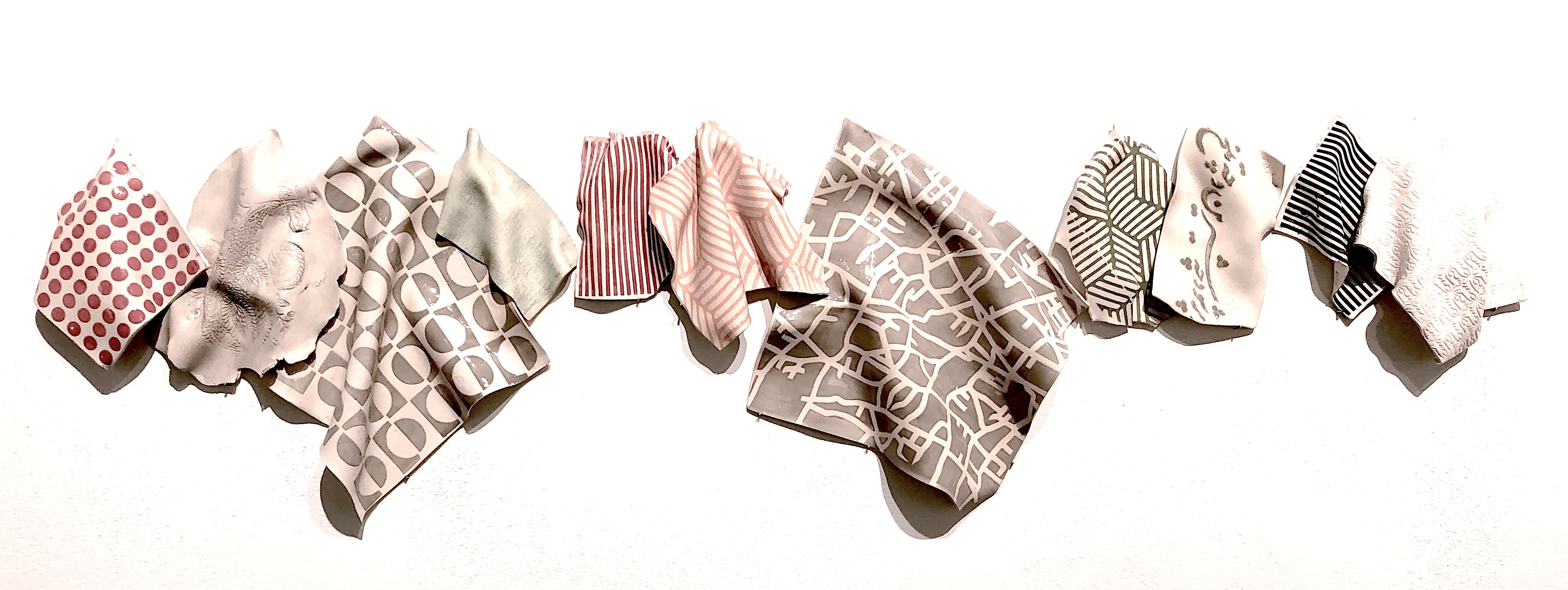
My artistic practice begins with this relationship between material and memory. I work primarily with ceramics, printmaking, cartography, and architectural patterns. I am interested in the way these different visual and material languages intersect. Maps become ornament. Architectural details become ceramic objects. Familiar patterns are reproduced, fragmented, and reconstructed through processes that combine digital precision with the unpredictable qualities of clay.
I’m drawn to combining ceramics and printmaking because they approach control in opposite ways. Clay resists perfection—it moves, warps, shrinks, and records the hand—while printmaking is built around precision, repetition, and structure. Bringing them together lets me work in the tension between control and chance, which has become an important part of my practice.
My background in architecture and cultural heritage has shaped the way I approach making. I see objects as part of larger environments and histories. A ceramic vessel can be connected to a domestic interior, a craft tradition, a landscape, a city, or a particular moment in time.
I am equally interested in the memory of places.
Over the years, my cultural work has taken me into historic cities, industrial neighborhoods, communities experiencing rapid urban transformation, and places affected by conflict and displacement. These experiences have led me to investigate how cultural memory exists beyond monuments and formally recognized heritage sites—in workshops, markets, streets, neighborhoods, agricultural practices, oral traditions, and everyday forms of gathering.
I use mapping, interviews, archival research, observation, and collaborative processes to document and interpret these histories. I am especially interested in the cultural knowledge carried by people whose experiences may be absent from institutional archives.
Migration adds another dimension to this inquiry. As an immigrant, I think about the relationship between the places we leave and the objects, habits, images, and memories we carry with us. I am interested not only in loss, but in the ways people remake familiarity and belonging in new environments.
My work in post-conflict and post-disaster recovery has also shaped my understanding of cultural continuity. When a place is destroyed, more than its physical fabric is lost. The relationships, memories, knowledge, and practices associated with that place can be disrupted as well. Yet culture also provides ways of rebuilding connections and imagining a future.
I move between making and researching, between individual memory and collective history, and between the physical qualities of objects and the cultural worlds they inhabit.
At the center of my practice is an ongoing inquiry into what remains, what changes, and what people choose to carry forward.

